 Building Scalable Disaster Recovery Platforms for Microservices Building Scalable Disaster Recovery Platforms for Microservices Dec 4th 2025, 15:00 by Akshay Pratinav , Sahil Sabharwal Introduction Disaster recovery is the process of restoring a business's IT infrastructure — including critical data, applications, and systems — after a catastrophic event to minimize downtime and resume normal operations. There is a common misconception that disaster recovery is just about database snapshot. In reality, it includes restoring application state, database, cache, traffic management, and infrastructure orchestration. Today's cloud-native environment, which consists of thousands of microservices, makes disaster recovery complex because it requires coordination across services, infrastructure, and dependencies. In large organizations, there are thousands of services to manage with varied technologies. Using a non-standard disaster recovery static script leads to inconsistent and error-prone disaster recovery execution. |  How to Use AI for Anomaly Detection How to Use AI for Anomaly Detection Dec 4th 2025, 14:00 by Laiba Noor You usually need AI when your data is just too much, too fast, or too complex for static rules to handle. Think about it: rules work fine when patterns are stable and predictable. But in today's environment, data isn't static. Anomalies evolve, labels are often scarce, and what's considered "normal" shifts depending on the service, the cloud, or even the time of day. If you're already drowning in alerts or missing critical events, you've felt the pain of relying on rigid thresholds. Analysts get overwhelmed, false positives eat up hours, and the real threats slip through. That's exactly where AI shines: it adapts to change, learns new behaviors, and balances precision with recall in a way that static rules simply can't. |  Encapsulation Without "private": A Case for Interface-Based Design Encapsulation Without "private": A Case for Interface-Based Design Dec 4th 2025, 13:00 by Mykola Haliullin Introduction: Rethinking access control Encapsulation is one of the core pillars of object-oriented programming. It is commonly introduced using access modifiers — private, protected, public, and so on — which restrict visibility of internal implementation details. Most popular object-oriented languages provide access modifiers as the default tool for enforcing encapsulation. While this approach is effective, it tends to obscure a deeper and arguably more powerful mechanism: the use of explicit interfaces or protocols. Instead of relying on visibility constraints embedded in the language syntax, we can define behavioral contracts directly and intentionally — and often with greater precision and flexibility. | 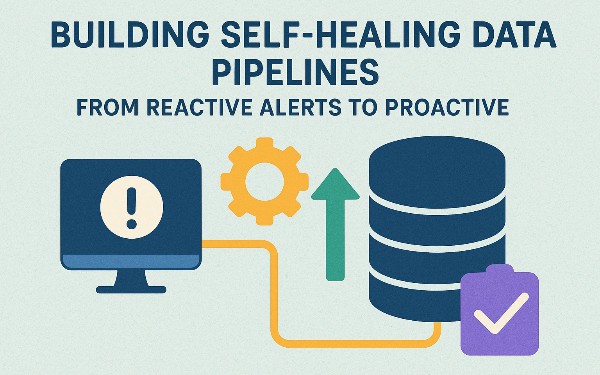 Building Self-Healing Data Pipelines: From Reactive Alerts to Proactive Recovery Building Self-Healing Data Pipelines: From Reactive Alerts to Proactive Recovery Dec 4th 2025, 12:00 by Janani Annur Thiruvengadam It's 3 a.m. Your Outlook pops: "Production pipeline down. ETL job failed." Before you even unlock your phone, another ping follows: "Issue auto-resolved by AI agent. Root cause: Memory pressure from 3× data spike. Fix applied: Scaled cluster, adjusted Spark config. Recovery time: 47 seconds. Cost: $2.30." | |


Comments
Post a Comment